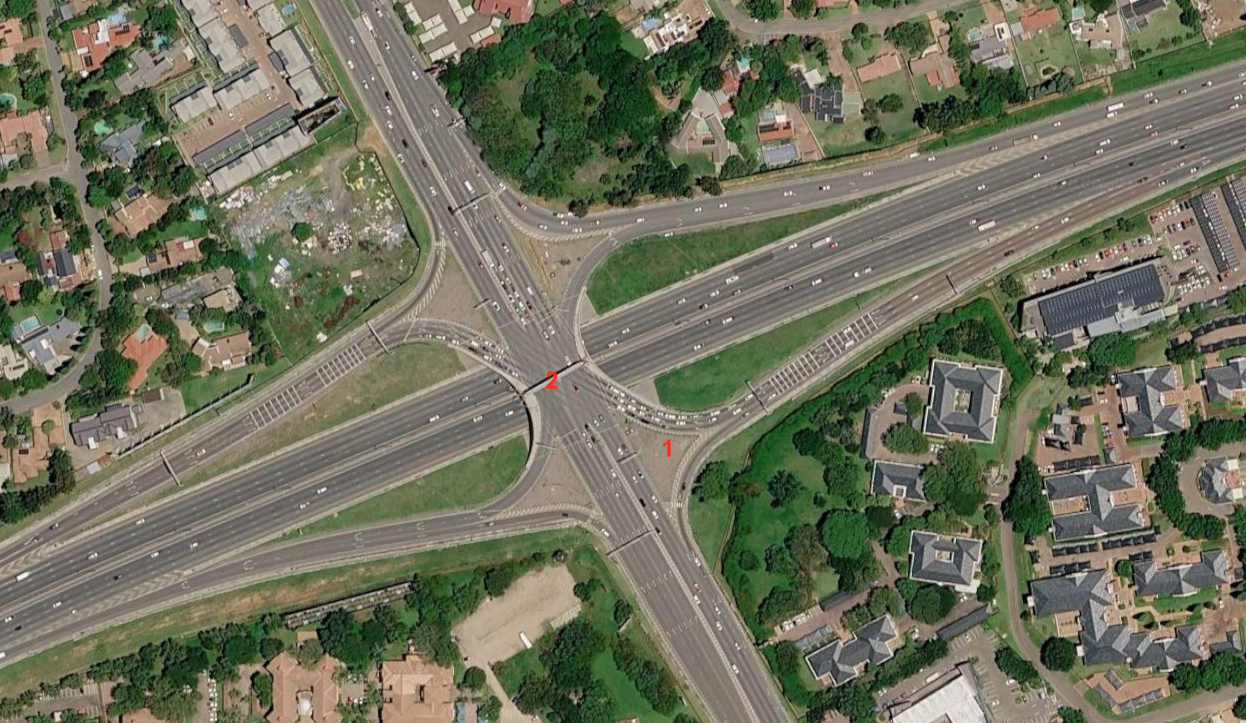
Aerial view of N1 Winnie Mandela interchange / Google Maps
The N1 diamond interchange at Winnie Mandela Drive in Johannesburg is probably the most important traffic portal on the continent in terms of economic impact. It is the single biggest chokepoint between Lanseria Airport and the gated communities stretching from Steyn City to Fourways in the north and Africa's richest square mile Sandton to the south.
If you are needing to make use of this interchange on an average business day, morning or evening, sorry for you… You are going to sit in traffic.
To understand why, we need to do some basic maths. Assuming a traffic light is green for 60 seconds, how many vehicles can we expect to pass through during that time?
It turns out there's actually a formula which looks like this:
$$N = \frac{G - l_1}{h}$$
Where:
- \(N\): Total number of vehicles.
- \(G\): Green light duration (60 seconds).
- \(l_1\): Start-up lost time. This is the 2-4 second delay caused by the first few drivers reacting to the light turning green.
- \(h\): Saturation headway. This is the average time gap between the front bumper of one car and the front bumper of the next once traffic is flowing steadily. In ideal conditions, this is usually about 2 seconds per vehicle.
So, assuming 3 seconds of lost time and a 2-second headway, the number of vehicles we can expect to pass through is:
$$N = \frac{60 - 3}{2} = 28.5$$
Note that 28-30 vehicles per lane is a rough estimate. Real-world variables will reduce this number:
- Driver Distraction: If the lead driver is looking at their phone, the "start-up lost time" can jump from 3 seconds to 6 or more, significantly reducing the throughput.
- Vehicle Mix: A line of passenger cars moves much faster than a line of trucks, which require more time to accelerate and larger safety gaps.
- The "Amber Light" Factor: In practice, the "effective green time" often includes the first second or two of the amber light, as drivers near the intersection choose to speed up rather than brake. This can sometimes add 1–2 extra cars to the total.
- The Minibus Taxi factor: These guys ignore the rules of the road and will execute illegal crossings into the front of the queue, disrupting the flow of traffic accordingly.
Looking at item 1 on the picture which is the flow of traffic from the N1 South turning right onto Winnie Mandela Drive, there are three lanes. Assuming 25 vehicles per lane in the one minute that the light is green, there's a maximum of 75 vehicles that will cross the intersection turning right in that one minute.
But the light is green for only one minute out of four, because the green lights have to rotate in favour of four streams, so that leaves 75 vehicles every four minutes making that right turn.
If there were only 75 cars waiting at the intersection at any time, there would be no traffic jams.
How many cars are there in the queue?
The backlog on the N1 South waiting to take that exit is often more than one kilometre long.
A standard passenger vehicle is about 4.5 metres long. In a standstill queue, the gap between cars typically ranges from 1.5 to 2.5 metres. Using an effective vehicle length (car + gap) of 6.5 metres, we can determine the capacity per lane:
$$\text{Cars per lane} = \frac{\text{Backlog Length}}{\text{Effective Vehicle Length}}$$$$\frac{1000\text{ m}}{6.5\text{ m/car}} \approx 154\text{ cars}$$
There are three inbound lanes giving us 462 vehicles in that 1km queue. As only 75 vehicles can move at a time, the person at the back of the queue will need to wait for 6 light changes (462 / 75) before turning. At 4 minutes per light change cycle, it's a minimum of 24 minutes to get from the back of the queue to turn right.
The backlog of cars waiting to pass through the intersection is the inherent limitation of a diamond interchange. The way to fix this for more than 100 years was to replace the diamond interchange with a variant of a cloverleaf interchange where all turns are handled by slip roads. Here's what that looks like:
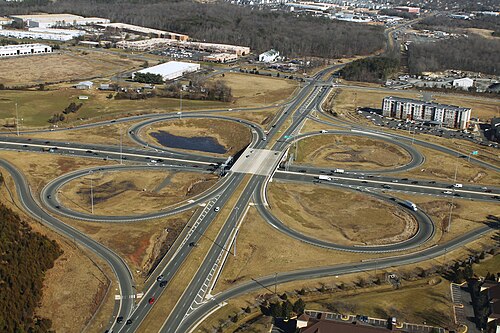
Cloverleaf interchange in Dulles, Virginia / Wikimedia Commons
Cloverleaf interchanges have no traffic lights, allowing for a relatively uninterrupted flow of traffic. This is unsuitable for the Winnie Mandela interchange because there is physically not enough space to build one there.
But there is space to redesign the traffic flow into a diverging diamond interchange.
Here's what that looks like:
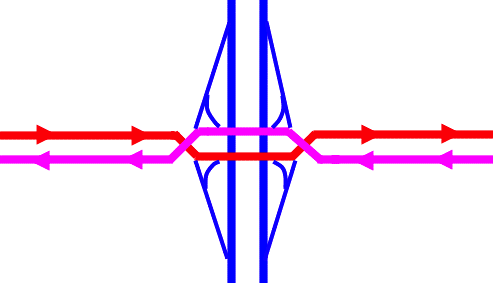
Diverging diamond interchange traffic flow / Wikimedia Commons
The opposing directions of travel on the Winnie Mandela drive are rerouted to cross each other on either side of the interchange so that traffic crossing the freeway on the overpass is driving on the right instead of on the left. This allows right-turning vehicles to access the freeway ramps without crossing opposing traffic.
Here's what the interchange would look like if we redesigned it as a diverging diamond.
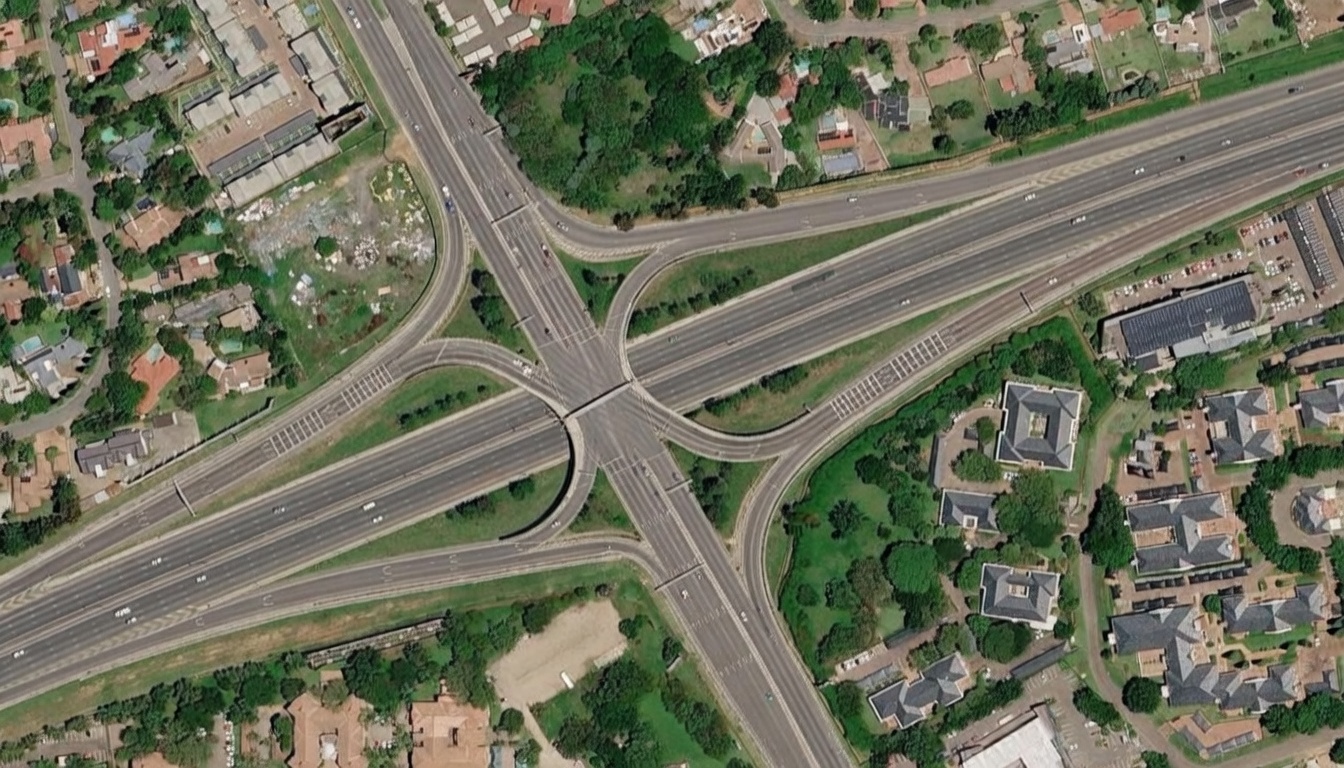
The Winnie Mandela N1 diamond interchange reimagined as a diverging diamond interchange
Here are examples of traffic flow:
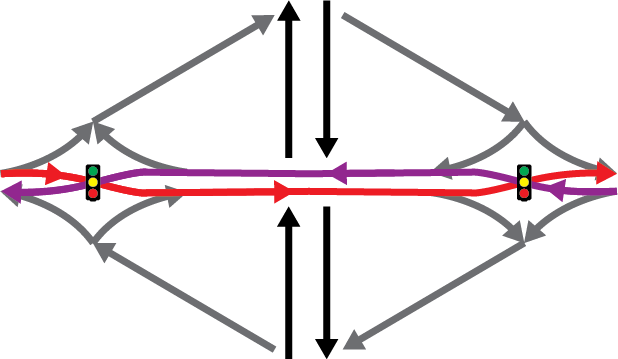
Straight across the freeway, traffic crosses over to the right and back to the left
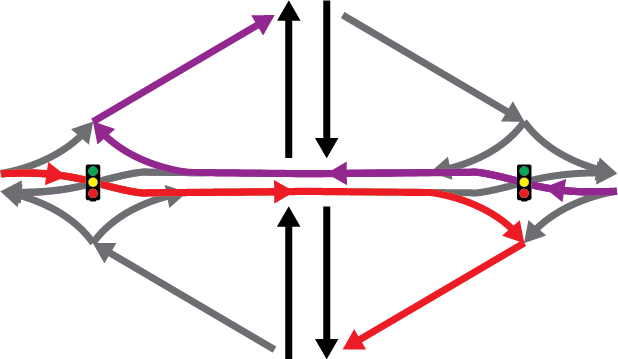
Right turns from Winnie Mandela onto freeway below
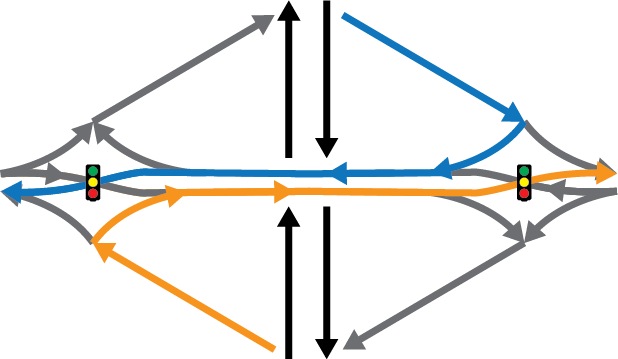
Right turns from freeway onto Winnie Mandela Drive
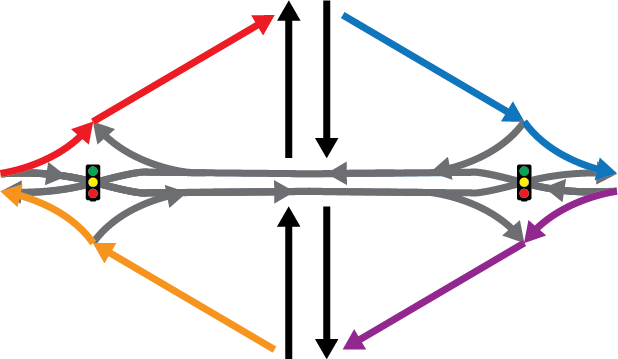
Left turns from freeway and from Winnie Mandela Drive
A modified version of a diverging diamond interchange is already in operation in Johannesburg; at the intersection of R55 Woodmead Drive and the M1, south of the Buccleuch Interchange. Here's what that looks like.
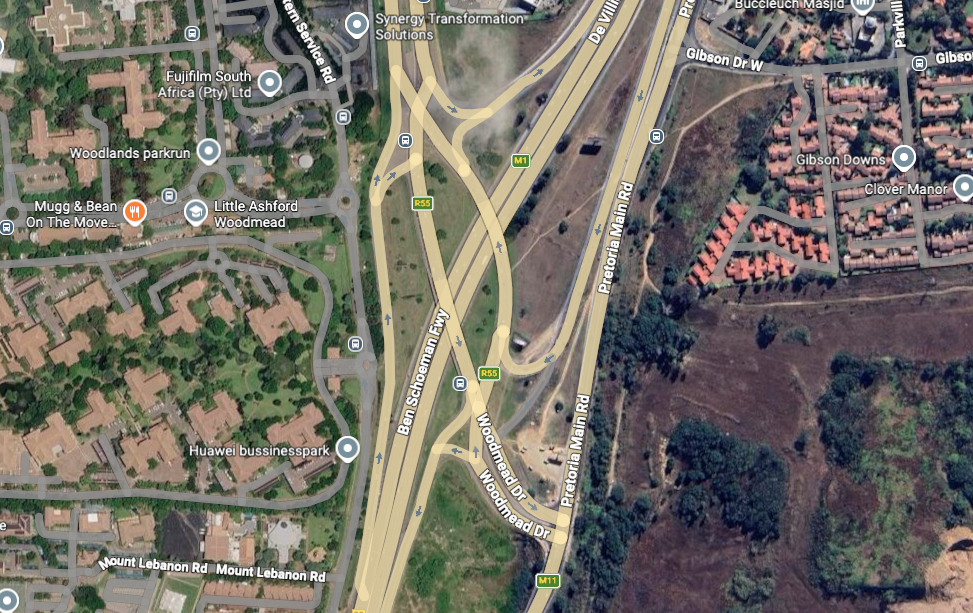
R55 M1 interchange, Woodmead Drive, Buccleuch / Google Maps
If you would like to see what these look like in action, there are plenty of videos — check them out.